
About us
None of this is separate from anything else
Hello,
Thank you for wanting to know a little more about Villa Paula. If you’ve read this far, part of your path is meeting ours, and we may have more in common than it looks.
What follows isn’t advice, and it isn’t a way of telling you how to live. It’s simply what we think, and why we do things the way we do.
There’s a book by Cortázar called Around the Day in Eighty Worlds. We like that idea that a person isn’t one thing but eighty at once. All we try to do is give those eighty worlds some coherence with one another. We don’t always manage it. But when we do, something odd happens: the coherence doesn’t sit still. It grows.
We call it the circle, for want of a better word.
A tomato grown in well-tended soil, picked ripe rather than green so it survives the journey, feeds you better. That’s health, plainly. That same tomato, being local, doesn’t travel, doesn’t spend weeks refrigerated and doesn’t lose on the way what it had, so it also costs the planet less. And because it’s grown here, someone local is paid to grow it. A single act, done with some judgement, does three things at once.
That’s the part that interests us most: the redundancy. When things are done for the right reason, the benefits overlap. You don’t have to choose between what’s healthy, what’s local and what’s fair, because they’re almost always the same decision taken earlier. And it usually tastes better too. It took us years to see that.
We’re no purists about it, for the record. We think a whisky, a beer, a good cigar or an ordinary burger are healthy too. We understand life as a set of balances, not a list of prohibitions. What we’re saying is something else: that doing right and enjoying yourself sit on opposite sides far less often than we’ve been told.
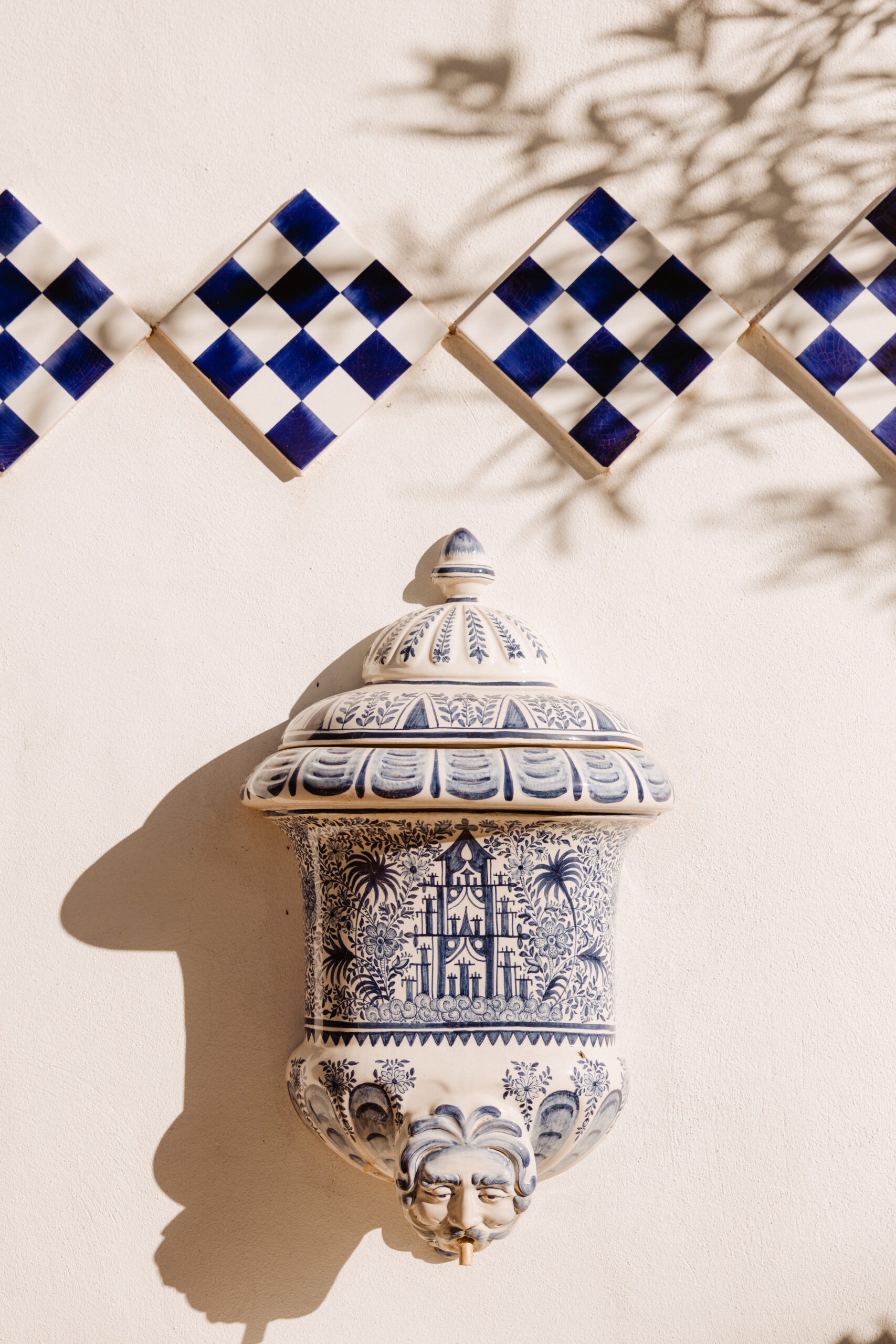
The same goes for what we inherit. On the façade there’s a Virgen de los Desamparados hand-painted on ceramic. Nobody knows who made it: two centuries ago these pieces were commissioned by families and painted one at a time. We restored it, and from the border around it, with its citrus and its horn of plenty, came an orange blossom that is our emblem today.
Look at what’s inside that. Two Valencians by adoption restore a Valencian Virgin, which is itself a homage to the culture of citrus, using the ceramic craft of this district. And out of that comes what represents us today. Nobody made us restore it. We did it because living surrounded by things somebody cared for is better than living surrounded by things nobody minds, and because the ceramicist who restored it lives half an hour away.
Nor is conserving the same as freezing. An irrigation channel runs past these plots, the traditional watering of the Valencian huerta, and it’s still in use. We don’t use it: flood irrigation soaks the ground and wastes a great deal of water, so the garden is on drip. The ceramics are kept because keeping them makes sense; a system that wastes water doesn’t. Looking after a place isn’t repeating what was done, but understanding why it was done and deciding what still makes sense.
We were looking for the Mediterranean and ended up here for something that isn’t usually on the lists: this land doesn’t live off the people who arrive. We’ve lived in places where a whole town waits for the season and people’s mood rises and falls with it. That doesn’t happen here, and it means a visitor isn’t a problem for anyone.
People have wanted to see the world for as long as there has been a world, and that won’t change; what can change is how. There’s a way of travelling that consists of making a list and crossing it off: arrive, photograph, leave. It leaves little to the traveller and less to the place.
Here we cook Valencian paella, asado from northern Argentina, Italian pizza and empanadas, and at some meals there’s flamenco, which is Andalusian and not Valencian. We know that and pretend nothing else. It’s here because when it meets a paella over the fire something hard to explain happens: people fall quiet. Saying where each thing comes from seems to us the only way to respect it, and to respect anyone who comes to know a place and deserves to know what they’re eating.
Almost nothing here was made by us alone. A ceramicist restored the Virgin, another painted the border, the rice is researched by someone who has spent years behind a single dish. Working this way costs more and is slower than buying ready-made. It’s also the only thing that makes this place unlike any other, and it means that when someone comes, the money stays within a few kilometres instead of going to a head office in another country.
There’s a part of all this we never imagined at the start, and it’s the part that matters most to us now. Having guests forces you to explain what you do, and in explaining it you understand it better and do it better. A guest asks why the tomato tastes like that, and that question changes next year’s garden. Someone stands looking at the ceramics, and we end up learning where they came from. Someone comes back, and that lets us keep giving work to people here.
Looking after the land, the art, the food and our guests don’t seem to us like four separate jobs. They’re the same thing seen from four sides, and every turn improves all of it a little. That’s also why we’re not interested in growing much: one house, one group at a time, enough time for things to be done properly. If this were bigger it would stop working this way.
At some point you understand that you’re only passing through, and that the passing should mean something. We don’t think about leaving a legacy; that’s beyond us. We think about being coherent while it lasts.
If you’ve read this far, you already know almost everything there is to know about this place. And if any of it resembles how you understand life, chances are we’ll meet.
Paula and Diego